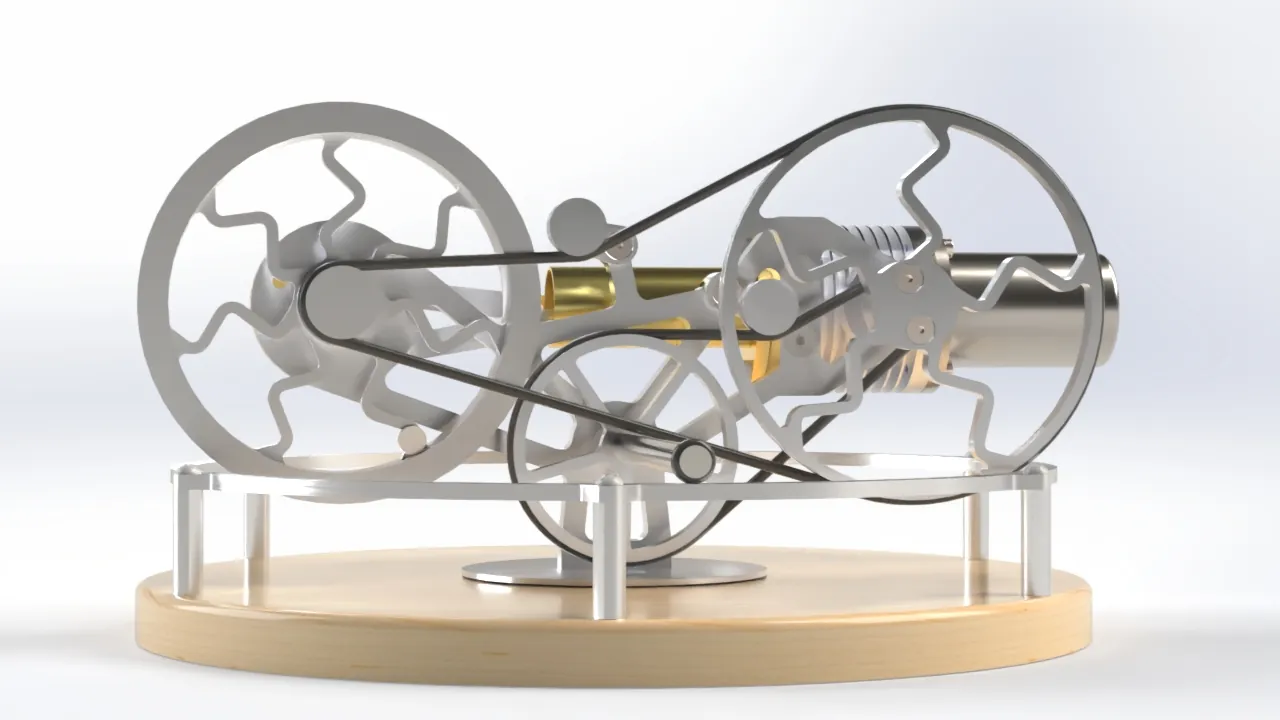
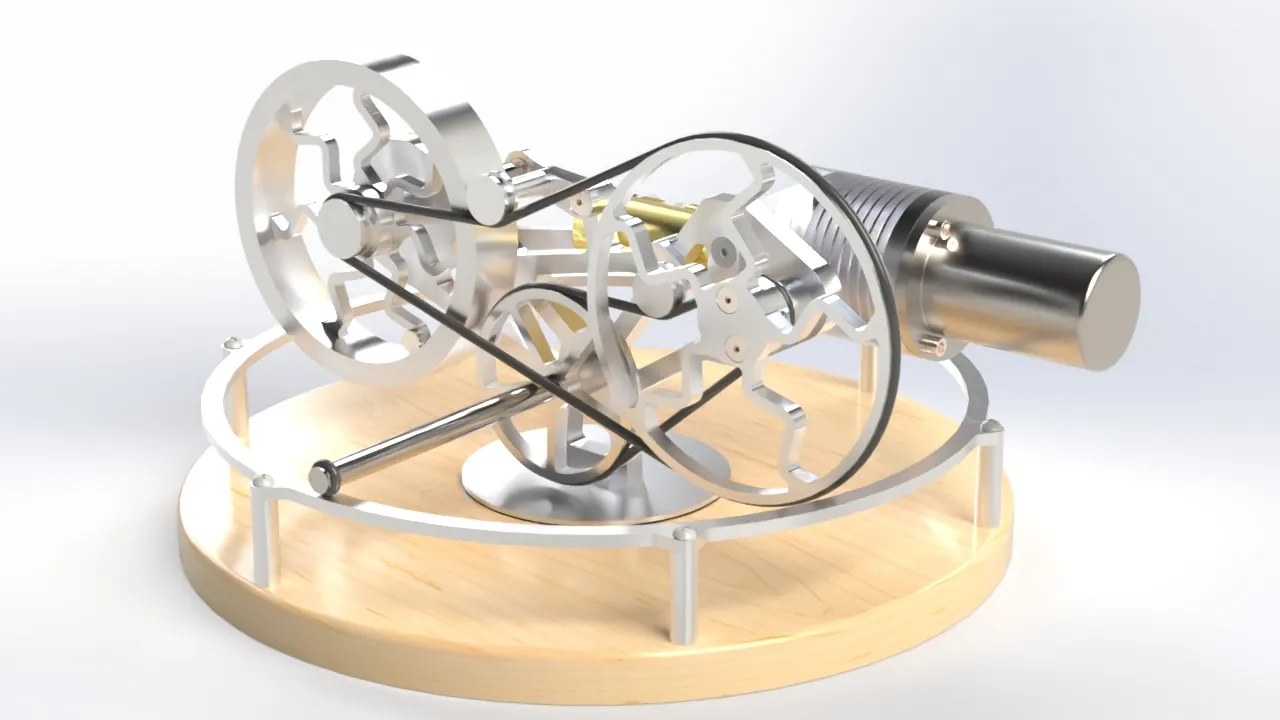
Self-Rotating Stirling Engine
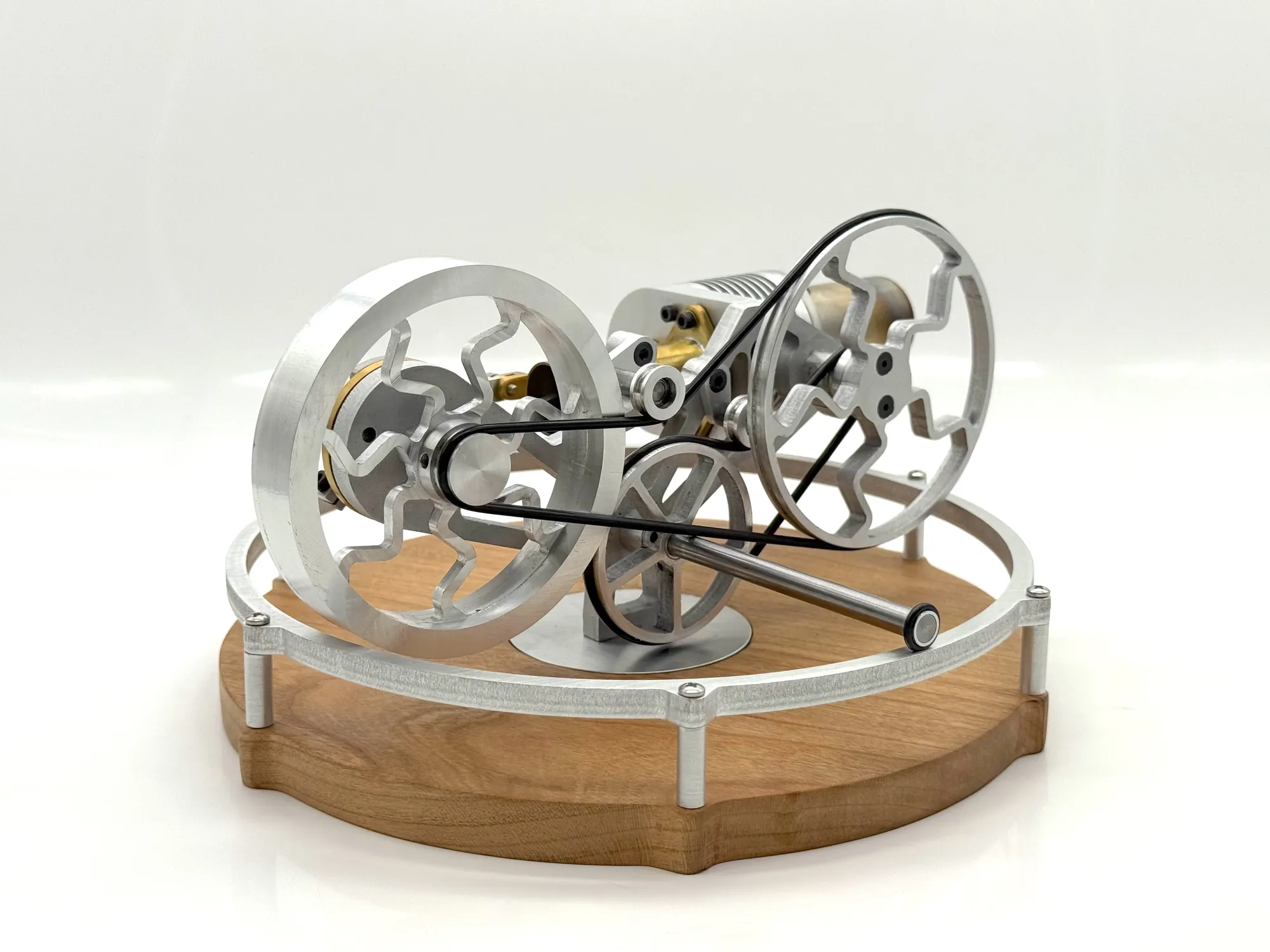
Stirling engines spin fast but make almost no torque. I wanted mine to do visible work, so a three-stage pulley reduction turns its flywheel speed into slow rotation of the whole engine around its base.
- Course
- Machine Design & Manufacturing (MEAM 2010)
- Date
- Spring 2026
- Role
- Sole designer and machinist
- Recognition
- Audience Choice Award
- Speed reduction
- ~400:1three o-ring pulley stages
- Engine speed
- ~1,600 RPM
- Machining tolerance
- ±0.001 inheld consistently on manual machines
- Shop time
- ~100 hrspracticing on manual lathes and mills
- Main material
- 6061 Albrushed; bead-blasted bedplate
- Award
- 1 of 2Audience Choice, class of 32
The idea
A Stirling engine runs on the temperature difference between its hot and cold ends. It is quiet and mesmerizing to watch, but it is a high-speed, low-torque machine: the flywheel spins quickly and can barely push anything.
I set out to get useful torque from it. A roughly 400:1 reduction, built from three stages of highly efficient o-ring pulleys, trades nearly all of that speed for torque, enough for the engine to drive itself in a slow circle around its base.
Design
- Modeled and assembled the full engine in SolidWorks, mixing a few purchased parts with many fully custom ones. Nearly every custom part was designed and manufactured by me.
- Produced detailed engineering drawings and applied GD&T, including a tolerance stack-up of the displacer assembly.
- Made the presentation renders in SolidWorks Visualize and KeyShot.
Manufacturing
- Learned the manual lathe and mill for this project, spending close to 100 hours practicing until I could consistently hold ±0.001 in.
- Wrote and ran CNC toolpaths with conversational programming and Mastercam, including the flywheel.
- Finished the major 6061 aluminum parts with a brushed grain and bead-blasted the bedplate for contrast. The wood base was sanded smooth and oiled.
Result
The engine reached about 1,600 RPM and turns itself around its base under its own power. At the final demonstration it won one of two Audience Choice Awards in a class of 32.